Monday, April 4, 2022

Financials Mock Portfolio Outperforms S&P 500 Index In the First Quarter (And Other Updates)

Financials Mock Portfolio Quarterly Performance Update

In January, we published a mock financial stocks portfolio. For the quarter, the portfolio returned +1.9%, which compared favorably to the S&P 500, which returned -4.6%, as well as the Financial Select Sector SPDR Fund (XLF), which returned -1.5%.

As a reminder, these results assume dividends are reinvested.

One of the positions, MoneyGram International (MGI), accepted a buyout offer from a private equity firm. We will assume a sale of that as of March 31, with the proceeds evenly reinvested in the portfolio.

2s/10s Yield Curve Inverted

We have written multiple times about the flattening yield curve, that is actually starting to invert. Historically, inverted yield curves have proven an indication of elevated risk of recession, and we argued that a contributing factor to this was Uncle Sam's large budget surplus in January. This is an unfortunate development from the Biden administration, which recently released a statement estimating a $1.3 trillion reduction in the deficit for 2022. That is an alarming amount, as it represents nearly 5% of US annual GDP. 

As a reminder, when the US Treasury runs a surplus, the net effect is a removal of reserves from the banking system, and our contention is that this is causing stress in the markets. Last week, the 2s/10s curve officially inverted for the first time since the summer of 2019, and remains so as we write this:


It's worth pointing out that in the Fed's latest weekly statistical release, it reported a $3.830 trillion reserve balance held at Federal Reserve Banks:


This represents a $286 billion reduction in reserve balances since the beginning of the year's balance of $4.116 trillion: 


One doesn't need a PhD in economics to understand that fewer reserves in the banking system leaves fewer dollars available to purchase securities. Is it any wonder then that US government bonds had their worst first quarter in nearly half a century? This has real economic consequences, average 30-year fixed mortgage rates exploded higher in the quarter, reaching their highest level since December 2018:


Liquidity Is Drying Up

Lack of liquidity in US Treasury market is also a major concern. Per Reuters:

"Some measures of liquidity have shown stress.

Bid-ask spreads -- a commonly used indicator of liquidity -- widened significantly in March on short-term Treasury notes, Refinitiv data showed.

Data from CME Group showed order book liquidity for Treasuries has declined since Feb. 24, when Russia began its invasion of Ukraine, and volatility has increased.

Cash contracts volume in terms of the daily average top of the book bid/ask quantity for five-year Treasuries declined to $10 million in March from about $25 million in February.

For the benchmark 10-year notes, order book liquidity went down to an average of $14 million in March from about $20 million in Feb."

And daily US Treasury FTD's (industry parlance for "Fail To Deliver") reached their highest in a year on March 31:


Source: DTCC

This further supports the assertion that markets are becoming stressed. It shows that financial intermediaries are having a difficult time sourcing and delivering Treasury securities that they are legally obligated to deliver in order for trades to settle and clear. It shows that collateral chains are being stretched and are at risk of breaking, which could be a precursor for a risk-off, flight-to-safety event. Certainly, the extreme activity in commodity markets due to the COVID-19 pandemic and the recent Russian invasion of Ukraine has sent tremors through financial markets. Talen Energy, a PA-based power producer owned by PE company Riverstone, is seeking DIP ("Debtor In Possesion") financing for a potential bankruptcy, thanks to commodity hedges that went against them and drained their liquidity. Altera Infrastructure (f/k/a Teekay Offshore) is another PE-backed company that is having liquidity issues; they have hired advisors for a potential restructuring.

Consumer Price Inflation Is Crushing Consumer Demand

Indeed, the current high prices for goods is weighing on demand. Consider last week's statements from RH CEO Gary Friedman:

Yes. All of a sudden, that hits. And then all of a sudden, boom, we've got a war. Russia invades Ukraine, boom. Yellen says interest -- inflation is going from 4% to 2%, and then it goes to 7.5%. And Powell says, we're behind. I think there's a lot of -- everybody thinks supply chains are getting better. I don't think they've gotten better at all. I mean, it is what it is. I mean, product is on the water for a long time. Getting ships into port is taking a long time. We've got generally about 5 extra weeks in our supply chain right now. That's a lot of time. It's a lot of money, and that's the average. So that means some steps coming on time and some steps 10 to 12 weeks behind.

And this:

Yes. Well, look, I mean, it's probably one of the most difficult guides since 2008 and '09 because we're right in the middle of this disruption from Ukraine and Russia, which I think -- I don't think it's all Ukraine and Russia. I think it's triggered a greater awareness. Like it's like someone -- I think this was ring the bell, everybody pay attention. And then all of a sudden, everybody started talking. Yes, all of a sudden, the Fed's off to the races, and that creates concern. You've got housing prices at all-time highs. I mean, is it sustainable? I don't know for how long the math. Yes, doesn't make sense on kind of what's happening in the housing sector and other places that -- you've got inflation like I've never seen.

Now I was telling people when Yellen said, "We're going back to 2%," we were just signing our new freight contracts, ocean freight contracts. I just wonder if anybody -- the Fed has picked up the phone and called a businessperson and said, "Hey, what do you think is happening with inflation? How's ocean rates? How is this? How is that?" I mean, I think -- I don't think anybody really understands what's coming from an inflation point of view because either businesses are going to make a lot less money or they're going to raise their prices. And I don't think anybody really understands how high prices are going to go everywhere, in restaurants, in cars and everything. It's -- and I think it's going to outrun the consumer. And I think we're going to be in some tricky space.

And how about this - Big Short/Bear Stearns reference:

But it's not just us. It's everybody I know in every industry. And I just don't think it's like -- again, I don't want to scare everybody. But I talked about the theme, like there's this scene in The Big Short where everybody is in that ballroom and the guy -- I think it's the guy from Bear Stearns or someone is up there, one of those things, and he's saying how they're going to buy back $1 billion of their stock, this, this and that. And then one guy who's on his BlackBerry, he goes, "Can I ask a question, sir? In the 20 minutes that you've been talking, your stock is down like 55%." And everybody ran out of the room.

I just think we tend to just try to be transparent and honest. And look, maybe our stock is going to take a big hit because of this, and people are going to think Gary Friedman wasn't excited. I've never -- I told my team, I've never been -- in my 22 years here, I've never been more excited. I've also never been more uncertain, right? So -- and I think you have to take a real balanced view right now.

Full disclosure - I own RH stock and have been following the company for years. I can confirm Friedman is very smart, capable, and tells it like it is.

I think there is a strong likelihood that consumers start pivoting away from spending on goods and instead increase spending on services such as travel and hospitality. This does not bode well for the goods economy, as inventories are high:


Source: Logistics Managers' Index

...and there are signs the trucking market is starting to roll over. The CEO of logistics data provider FreightWaves (highly recommend you check out their services) just wrote a piece predicting an imminent recession, which followed a piece written a week earlier calling for a repeat of the 2019 "bloodbath" in the trucking market:

We think another sharp, painful downturn in the U.S. truckload market is imminent, and it could be as bad as 2019.

March has been unusually soft in the truckload freight market, according to the SONAR Outbound Tender Volume Index (OTVI). Because this index measures actual truckload tenders in the contract market, it provides a very reliable indicator of market direction. 

March is typically a strong month for trucking, as shippers start to stock their shelves in preparation for summer. And late March normally gets a reliable end-of-quarter boost in volumes as shippers pump sales and reduce inventories. This year, we are not seeing that surge. In fact, March volumes are softer than at any point in 2021 (other than holidays). 

Outbound tender volumes are down:


Additional commentary from the same article:

More than likely, the lower volumes are due to a major consumer slowdown. Inflation that began in 2020, combined with the surge in fuel prices related to increased inflation and the Russian invasion of Ukraine, have made consumers move to the sidelines. In addition to monitoring SONAR data, FreightWaves analysts also conduct channel checks through our network. Market participants are confirming what FreightWaves analysts are seeing in the data. Spot rates are falling fast and volumes are dropping.

There are many reasons to believe that the freight market slowdown will continue, and that an oversupply of trucking capacity – particularly in the spot market – will pull rates even lower.

Freight is all about the movement of physical goods. Travel and entertainment do not drive (much) freight, so any dollars spent on “experiences” means money isn’t spent on cargo. 

After two years of massive consumption of physical goods, consumers are pausing their spending. The COVID surge is largely behind us and people are starting to shift their spending away from physical goods to travel and entertainment, which will take a much larger percentage of disposable spending than we have seen over the past two years.

If traffic is any indication, consumers are on the move right now and this requires fuel. Except for the 3% of the U.S. population that have electric cars, any money spent on filling up the gas tank will mean less money going toward discretionary spending. 

Everything is more expensive than it used to be and consumers are starting to be more cautious about the future. High fuel prices and runaway inflation sap consumer confidence and will be a drag on discretionary purchases. 

The trend toward intensive goods spending has taken longer than many initially expected to reverse itself, but consumer spending data confirms that a material shift is taking place. February retail sales were nearly flat at 0.3%, missing expectations.

Over the past two years, shippers were short of inventory. In an attempt to prevent stock outages, they ordered more than they needed and now are faced with a hangover from ordering too much. Key transshipment infrastructure like ports, warehouses, transloading facilities, and intermodal ramps were clogged, slowing freight velocity, reducing sales, and increasing inventory levels. FreightWaves’ view is that shippers will compensate by slowing their purchasing and working off inventory when opportunities with acceptable margins arise.

Trucking spot rates are under massive pressure, caused by too many trucks and not enough freight. Truckstop.com’s truckload spot rates peaked at $3.83 per mile in January and are now down to $3.42 per mile. Spot rates will fall further and could hit $2.50 per mile by mid-year.


Trucking has enjoyed the largest number of new entrants in its history over the past two years. New fleet registrations were up to 20,166 last month alone. This is unprecedented. The last peak was in August 2019; there were 9,511 new trucking fleets and that was in the middle of one of the weakest freight markets in history. New trucking registrations tend to lag market conditions, so we can expect new fleets to continue to enter the market, even after things soften. This will make the downturn that much worse.


Many of the operators are unseasoned and inexperienced. They are unlikely to have ever seen a market downturn, much less run a business in the middle of one. They also bought their trucks and hired their drivers at the top of the market. 

These same drivers that were chasing high spot volumes will find fewer and fewer opportunities in the market. They will either leave the trucking market or move to trucking companies that have more consistent freight, leaving those trucks unseated. 

With falling spot rates, declining volumes, surging fuel prices and inflation across the board, it will get ugly, very quickly for many of these operators. Back in 2019, FreightWaves reporters wrote about trucking bankruptcies almost every day. I expect this will become reality for us once again.

We Should Stop Talking About Wealth "Redistribution"

One of the most common disagreements I hear in political discussions is over the notion of wealth "redistribution." See the NY Times article from over the weekend: Thomas Piketty Thinks America Is Primed for Wealth Redistribution. I think it would be best to avoid this phrasing, for several reasons. First, it gives the impression that wealth is zero-sum. MMT shows us that when the government runs a deficit, it creates non-government surpluses that are commonly thought of as wealth. When the government spends money in a non-inflationary manner, it creates financial wealth for the recipient. The wealth didn't have to "come from" anywhere. We can all be collectively wealthier without taking anything from anyone. Additionally, "redistribution" is generally used in a context where someone "earned" that wealth fair and square, only to have it confiscated by the evil, power-hungry government. We need to remind people that the government is the original source of their wealth, both financially (government is the original source of our modern money) and by virtue of granting property rights and enforcing contracts, which forms the basis of our modern capitalist system. Finally, talking about "redistribution" makes it seem like we need billionaires for essential funding. We don't. It's actually the other way around: they need us to buy their products and tolerate laws that allow them to accumulate their fortunes.  

ECASH Act: A Step In the Right Direction

I'd like to end this post on a positive note. A bill called the ECASH Act was recently proposed in the US House of Representatives. The bill "directs the Secretary of the Treasury to develop and pilot digital dollar technologies that replicate the privacy-respecting features of physical cash, in order to promote greater financial inclusion, maximize consumer protection and data privacy, and advance U.S. efforts to develop and regulate digital assets." (For more information, see here https://ecashact.us/)

This is a great development for civil liberties, right to privacy, and financial inclusion. It makes sense to have the Treasury pilot the program given its history of rolling out products designed for individuals. Physical cash is a different "form" of money than ledger cash, which requires maintaining a historical record of transactions. This bill essentially gives the Treasury a green light to create digital dollar that is more compatible with today's digital world.


Wednesday, March 23, 2022

General Equilibrium Theory is Nonsense

General Equilibrium Theory is nonsense. We live in an uncertain world and can't predict the future. Households and firms hoard assets (cash, securities, inventories) in order to provision themselves should they be needed in the future. If equilibrium theory was correct, and markets were perfectly efficient where supply magically balances with demand, there would be no inventories. All this "buffer stock" savings requires financing. Purchasing inventories, securities, or holding cash are uses of funds, and require an original source. While banks typically finance inventories and securities, and hold cash deposits, the ultimate source of funds is the government. This shouldn't be controversial, considering that private banks hold their own deposits at the relevant central bank. And these deposits are liabilities of the central bank, which are typically guaranteed by the full faith and credit of the government.

Pizzanomics

What equilibrium theory also gets wrong is the idea of markets "clearing" for goods and services. This concept is relevant in financial markets, assuming equal access to information and rational actors. However, it doesn't apply in the same way for the exchange of goods and services in the real economy, because of the impact of power structures on the means of production. Consider the following: an Italian immigrant comes to America and sets up a pizza shop in a town where no one had ever previously heard of pizza. Setting up a pizza shop requires a permit from the local government, and money to use up front to pay for rent, purchase equipment and supplies, and perhaps hire a worker. It's not likely the Italian would have access to financing from a bank, because this is a novel concept and banks aren't usually in the business of making risky loans. So, already there is a bias in that the Italian already had money, and the local government gave its stamp of approval on his new business venture. It wouldn't be possible otherwise - the Italian would end up in jail if he broke the town's laws by setting up his business without a permit. So already, the Italian has been granted the privilege of having money and being allowed to run his business. This gives him power over the means of production. And because no one in the town has had pizza before, there is no demand that his supply of pizza can balance with - the power granted to him by the local authorities allows him to create his own demand!

The Freedom to Buy Only What Corporations Want to Sell You

Another example is wholesale food suppliers. Oxfam put together this graphic several years ago to show how just ten companies control most of what we buy for groceries:

Source: https://www.businessinsider.com/10-companies-control-food-industry-2017-3

How can we look at something like this and say we live in a country with competitive, "free" markets? The level of concentration on such a critical portion of the means of production in our economy, where production is controlled by a handful of powerful bureaucrats, more closely resembles failed states like Venezuela and the USSR, where control over the means of production was monopolized by the government. And yet, we still call this "capitalism." No wonder we've been dealing with toilet paper shortages (among other items).

The high industry concentration leaves few alternatives, enabling these companies to have incredible pricing power over consumers. This power dynamic obliterates the equilibrium theory narrative, as sellers in these transactions are price makers, and buyers are price takers. Sellers can raise prices without a change in demand. Which is exactly what they're doing, by the way, contributing to the recent surge in consumer prices. So no, the market is not "clearing" at its "natural equilibrium" price. The distribution of power in a society has profound effects on economic outcomes.

Everyone Has to Pay Taxes

Speaking of grocery stores, why can't we use any currency other than dollars to transact at them? In a free country, shouldn't I be allowed to show up to the grocery with my bananas and exchange them for oranges? Or pay for oranges with unmarked gold coins? Or Bitcoin?

Obviously, the answers to the above questions are all the same: no. The reason is simple: the grocery store owner has to pay taxes on income generated from its operations. The landlord who owns the property and collects rent from the grocery operator has to pay income and property taxes. The utilities and insurance companies that service the grocery operator have to pay income taxes. The wholesale food suppliers have to pay income taxes. The workers who collect wages to run the store have to pay income taxes. Everyone has to pay taxes!

And what currency are those taxes paid in? In the US, by law taxes must be paid in dollars. So, the government coerces the citizenry to all pay taxes in a currency for which it is a monopoly supplier. As laid out brilliantly by Warren Mosler and Stephanie Kelton, the ability to levy a tax in dollars is the key to creating demand for them. Once again, it's not a market dictated by buyers and sellers. It's an example of a powerful entity - the US government - creating demand for its product that did not previously exist. No one was born with a desire to accumulate dollars; there is no "natural" demand for them, just like there is no natural demand for pizza. The demand comes from people's desires to stay out of jail.

Every year, the government is guaranteed to require us to pay taxes. Even Americans who don't technically pay federal income taxes do generally transact in the domestic economy, and taxes are embedded in the cost of every product or good they purchase. Sales taxes are prevalent in 45 out of 50 states in the US. And while renters may not pay property taxes, the rental outlay paid to the landlord sure does, which manifests in the rental rate.

Cue: The Job Guarantee!

Many Americans, particularly those on the political right, despise paying taxes. I'm sympathetic to this line of thinking, but MMT shows us the anger is misplaced. The real injustice is that the government guarantees the People have to pay taxes in its currency, without guaranteeing the People opportunities to obtain said currency. In fact, it's even worse: the government proactively restricts opportunities for people to obtain its currency, through its administration of monetary policy and the Fed's "dual mandate" for maximizing employment and stable prices as set by the Congress. This is not just cruel; it's an abomination. People suffer and go hungry as a result of these policies. Congress' refusal to extend the Child Tax Credit has inhumanely forced children into poverty. And what do we get out of this? Elevated levels of poor health, chronic disease, anxiety, depression, and lower academic achievement, among other things. Enacting a federal Job Guarantee would go a long way towards eliminating child poverty. It is my genuine belief that a Job Guarantee (or "Employer of Last Resort" if you prefer) is not only one of the most important legislative proposals of our generation, it can also serve as a bridge between the political left and right in our country. Neither side wants to be perceived as being "anti-work." And, a federal Job Guarantee would perhaps make paying taxes less miserable in the eyes of conservatives, as they can always get a job to cover their tax debts. 

Tuesday, March 1, 2022

Mo' Problems Mo' Money

First, my heart goes out to all the citizens of Ukraine who are experiencing this horrible tragedy. There simply is no place in the modern world for the tragic death and destruction that Putin has unleashed. I hope and pray for a peaceful resolution and an end to this senseless violence and suffering.

This whole experience had me thinking over the weekend about how inflation has been historically been high during war times. The typical narrative offered by people is that governments "inflate away" the financial debts incurred during the war.

Indeed, most people generally believe that inflation (i.e. rising prices of goods and services) is the effect of governments "printing money."

But what if this is completely backwards? What if higher costs of goods and services (in real resource terms) is actually the cause of money printing?

Money comes from two sources: the government and commercial banks. New commercial bank loans are "funded" with newly created money deposits. Banks have a special government license to create new money on its behalf. Banks are money printers.

When problems arise, that compels entrepreneurs and/or governments to solve them. Doing so requires new money creation.

Let's say a community's hospital is destroyed thanks to an unprovoked invasion by a psychopath (i.e. what is happening in Ukraine right now). That hospital was funded by either the government or a bank creating money to pay for it. The loss of the hospital represents a real economic cost, because hospital buildings generally have multi decades of useful lives, and sick and injured people can no longer be treated there. This represents a real resource deficit. In order to get back to square, in terms of real resources, either a bank or a government must create new money. This will obviously increase the "money supply," as the new money is added to the money that funded the original hospital. So, in order to deal with a real resource problem, we have to first create new money.

That's not to say that printing money in and of itself solves problems. But addressing real resource deficits requires printing new dollars. Real resource deficits represents real costs to people: the hospital that got destroyed by definition creates a deficit for healthcare facilities. This limits people's access to such services and is an increase in real resource "costs." The real resource costs requires money printing to be dealt with.

Likewise with the pandemic, which created a strain on real resources. It made life more difficult for people. The inflation we've been experiencing reflects the problem of real resource deficits. Money printing is the effect, not the cause. Recall that corporations drew down billions of dollars' worth of credit lines in March 2020 in order to preserve cash and liquidity given the uncertainty posed by the pandemic. That represents rapid money printing in a very short period in response to a real economic problem. That new money creation by itself did not cause consumer prices to go up.

And this isn't anything new. An economy can accurately be described as people using real resources to solve problems for other people and create real-world prosperity. If a town lacks a pizza restaurant, an entrepreneur may view that as a problem to be solved. While they may have some money saved to open the restaurant, they usually require a loan from a bank as well, to fund purchases of equipment and working capital to hire people and pay suppliers for ingredients. That bank loan represents new money creation.

More problems leads to more money creation.

Wednesday, February 23, 2022

Debunking the "Magic Helicopter" Myth

Over the weekend, the WSJ published an opinion piece titled "How Government Spending Fuels Inflation." The piece was written by Tunku Varadarajan, who summarizes arguments made by John Cochrane, an economist and senior fellow at the Hoover Institution.

This was an unfortunate piece, and is especially disappointing for an esteemed publication such as the WSJ. Like most mainstream economists, Cochrane confuses correlation with causation. He notes that federal debt has increased by 30%, then rhetorically asks "Is it at all a surprise, that a year later inflation breaks out?"

Statements like this may sound intelligent on their surface, but his assertions are in no way supported by facts. The below chart compares year-on-year percentage change in total federal debt with the year-on-year growth rate in CPI. There were similar percentage increases in total federal debt in 1983 and 2009. Notably, neither of those periods led to excessively high growth rates in consumer prices:


Indeed, the recent inflationary episode is the exception, not the norm. So if increasing the federal debt has not historically led to an accelerated increase in CPI, why is this time different? There are myriad reasons for this, including the fact that we were going through a global pandemic, temporarily shut down the economy, then reopened it, and are dealing with the consequences. Supply chains have completely blown up. Chip shortages are restricting production of new automobiles by the OEMs. Americans consumed an unusually high amount of goods relative to services. Our national infrastructure is generally degrading thanks to multiple decades of underinvestment. None of this has anything to do with the level of federal debt outstanding.

Cochrane goes on to promote his upcoming book, The Fiscal Theory of the Price Level, in which he will apparently claim that inflation happens when the government borrows more money than people expect it to repay. If this sounds like complete nonsense, that's because it is. First of all, as per the 14th Amendment, the US federal government is required by law to repay all of its debts outstanding. Second, generally speaking people don't spend their time assessing the "creditworthiness" of the US federal government. The yield on US Treasuries are called the "risk-free rate" for a reason. The federal government has no limits on its ability to meet obligations denominated in its own currency. If you talk to any actual business owner in real life, most of them won't even be able to tell you how much debt outstanding there is ($30 trillion). Frankly, most of them probably won't be able to recite our nation's annual GDP! ($24 trillion). And that's among people who work in business. Does this guy actually think that non-business people spend time thinking about whether the US can "pay back" its debt? It's an utterly delusional assertion. The only people who talk about this stuff are economists and people in finance. Participants in the "real" economy don't actually know or care. Most people spend time thinking about how to pay their bills, feed their families, engage in extracurricular activities, and take care of their loved ones. The idea that consumers adjust the price they are willing to pay for goods and services based on their perception of the government's capacity to service its debt is absurd. I am embarrassed on the WSJ's behalf for publishing such drivel.

But that's not the only example of Cochrane conjuring fairytales in lieu of the real world. He likens the US Government's stimulus package to Milton Friedman's infamous "helicopter drop." I don't know about you, but I don't recall seeing bags of dollar bills being dropped from magic helicopters a year ago. In the real world, in the United States of America, on Planet Earth, money is created when either the US federal government spends more than it collects in taxes, or when banks create new loans. These new dollars are simultaneously assets and liabilities. Cochrane's analogy of a magic money helicopter is not only silly, it's also just the completely wrong. It implies that money appears out of nowhere, existing as a fixed stock of a scarce, commodity-like resource. It's as if cash exists only as an asset. In reality, we know that the cash in our pockets is our asset, and simultaneously a liability of the Federal Reserve. Cochrane, and those of his ilk, fail to understand this, and rather than engage in serious, useful discourse, instead resort to fantasies, fairytales, fables, and frauds.

Cochrane claims that when the government issues too much debt, people sell said debt to "buy other things," thus driving up the price of everything. This is just an asinine assertion. Cochrane doesn't seem to be much of a markets guy, so perhaps he doesn't understand that every sale has a purchaser. If "everyone" knows that the government has issued too much debt, and this has led the price of everything else to go up, why on earth would there be any buyers? It's just a ridiculous claim to make. It's also worth noting that people generally buy Treasury securities because it is a safe place to park one's savings. That is money that is put aside for future spending. Why would the government issuing additional debt compel people to all of a sudden spend away their savings? None of this makes any sense.

Let's pretend for a second that MMT is wrong, and that the US federal government does indeed need to "borrow" money from the private sector to fund its deficits. Even if this were true, it's noteworthy that, as Cochrane points out, the US national debt has increased by 30% since the beginning of the pandemic (> 30% since mid-2019). So, nearly 2.5 years after increasing its debt by > 30%, and inflation reaching 7.5%, logically one would expect the interest cost on such debt to be higher, right? As it turns out, the yield on the 10-year Treasury is almost exactly where it was back in mid-2019:


It's these types of thought experiments that compelled me to question conventional economic theory, and eventually embrace MMT. After all, if your theory can't explain and/or predict reality, then what good does it do? Nearly everyone on Wall Street laments how interest rates "should be" higher. This reflects the disconnect between how they think the economy and public finance works versus how it actually works. They stick to their dogma, rather than being open-minded and realizing that orthodox economics is wrong. They are modern-day flat-earthers, convinced their worldview is correct despite all evidence proving otherwise. 

Their ignorance creates our opportunities.

Before wrapping this post up, I wanted to share two data points which support assertions made in our previous post. Specifically, we wrote the following:

"...by far the most consensus trade for HFs has been “long growth, short value.” So, as reserves were transferred out of the banking system, margin lenders were forced to call in their loans, forcing HFs to de-gross their portfolios. By de-grossing, they sold their “growth” stock longs and covered their “value” stock shorts."

The folks over at Grant's Interest Rate Observer agree that, per FINRA, a substantial de-grossing has taken place as margin balances are falling off a cliff (emphasis added):

"As stocks rolled over to start the year, domestic margin debt collapsed by a record $85 billion in January vs. the previous month, data from the Financial Industry Regulatory Authority show.  Despite that downward lurch, the outstanding $830 billion figure at the end of January compares to $799 billion a year ago and sits far above the $562 billion in January 2020, before the bug barged in."  (source: Almost Daily Grant's https://www.grantspub.com/resources/commentary.cfm)

How they don't make the connection that the largest contraction on margin debt ever coincided with one of the largest treasury surplus months ever is beyond me.

And, per Goldman Sachs, hedge funds have generally performed terribly, because as stated, they have all piled into the same long growth/short value trades:


Friday, February 18, 2022

Unexpectedly Large Treasury Surplus in January Is Creating Stress In the Markets

Most people generally accept and understand that the Fed executes its monetary policy operations through the FOMC by purchasing or selling US Treasury securities and, in doing so, adding or removing reserves from the banking system. It isn’t controversial or insightful to say that an increase in the supply of reserves causes rates to come down, and vice versa when supply decreases. Per the Fed’s website:

“To raise the FFR, the Fed decreases the supply of reserves by selling U.S. Treasury securities in the open market. The decrease in reserves shifts the supply curve left, resulting in a higher FFR.

To lower the FFR, the Fed increases the supply of reserves by buying U.S. Treasury securities in the open market. The increase in reserves shifts the supply curve right, resulting in a lower FFR.”

However, what most people do not understand and/or acknowledge is that US budget deficits (i.e. Treasury cash outlays exceed inflows) are achieved by the Fed adding reserves to the banking system, and budget surpluses (i.e. Treasury cash inflows exceed outlays) are done by the Fed removing reserves. A 2018 paper released by the Chicago Fed makes this explicitly clear:

“When the U.S. government makes a payment, funds are withdrawn from the TGA [Treasury General Account] and sent to the bank accounts of individuals or businesses. These transfers increase the reserves of the commercial banks that hold the private accounts. Similarly, when the government receives a payment, the source of the payment is an individual or business account at a commercial bank and, ultimately, the reserves of the commercial bank.”

Orthodox economics tells us that a government which runs chronic budget deficits will eventually be forced by the bond market to pay higher interest rates as punishment for “profligate spending.” One of the critical insights of MMT is that, by looking at the order of operations of our monetary system, this “bond market vigilante” theory is complete nonsense. Per the above, budget deficits increase the supply of reserves in the banking system, and increasing the supply of reserves in the banking system leads to lower rates.

This is overwhelmingly supported by empirical evidence. Consider Japan. Like the US, the Japanese government issues debt in its own currency, and has been running large fiscal deficits for the last 30 years. Over that time, the interest rate on the 10yr JGB has gone from 5% to basically 0%:


Same goes in the US. Aside from a short period in the late 1990s/early 2000s, the US has been consistently running budget deficits for the last 30 years. As MMT would predict, rates have been falling over that same period:


Notice, too, how a recession followed shortly after fiscal year 2001 budget surplus. When the US government runs a budget surplus, that leads to the Fed removing reserves from the banking system. It is a de facto rate-hike, and takes away financial resources from the non-government sector. The weakened financial position increases the likelihood of a recession.

I bring this up because the BLS recently released the January budget figures, and it turns out the US government ran a budget surplus of $119 billion, the first since September 2019 ($83 billion), and an unusually high amount for the month of January. Market participants might recall the big Repo market blow-up that took place in September 2019, where stress in overnight funding markets caused the Secured Overnight Financing Rate to spike unexpectedly:

As the Fed explains, this was basically a timing issue: there was an insufficient supply of bank reserves due to higher-than-expected tax collections by the Treasury on September 16, which coincided with a $54 billion Treasury debt sale settlement, both of which caused a rapid $120 billion decline in bank reserves. This brought the aggregate level of reserves down to its lowest level since 2012. The lack of reserves increased bank borrowing needs, which spooked lenders (mainly Federal Home Loan Banks or FHLBs) and caused them to pull back on collateralized loan advances.

Let me repeat: insufficient reserves caused overnight rates to spike. That is precisely what MMT predicts! More reserves lead to lower rates, less reserves lead to higher rates. Given that fiscal deficits add reserves, that means that fiscal deficits lead to lower interest rates, and surpluses lead to higher rates. This stands in direct contrast to the mainstream view that fiscal deficits will (eventually) lead to higher rates. It’s all a gigantic lie/myth/fraud, perpetuated for decades by Wall Street, the media, policymakers, and academics.

So what happened in January 2022 when the Treasury ran a budget surplus, removing reserves from the banking system? Exactly what we would expect to happened: rates rose! This past January saw the largest fiscal surplus ever for the month of January. Lo and behold, the rates on US Treasury securities exploded. The secondary market rate on the 3 month US T-bill went up by 4x in a month, from 6bp to 24bp:

This unexpected event caused funding stress in money markets (as evidenced by the rapid rise in rates) which subsequently caused a decline in the stock market, as leveraged traders (read: HFs) had their margin loans called by banks and were forced to de-gross their portfolios. As a result, the NASDAQ had its second worst January performance ever (January 2008 was the worst) and the S&P 500 and Dow Jones Indices each had their worst overall monthly performances since the pandemic-induced panic in March 2020.

But not all stocks were treated equal over this period. “Growth” funds got absolutely slaughtered: Whale Rock Capital lost 15.9%, Tiger Global lost 14.8%, and Melvin Capital and Light Street Capital each lost 15%. Meanwhile, so-called “value” stocks performed exceptionally well. In fact, quant fund giant AQR’s value fund posted its best month ever this past January. The media has dubbed this the “great rotation” into value stocks. While I would love to see a secular rotation into value stocks, I am skeptical of this explanation. The more rational reason for this performance discrepancy is that for years, by far the most consensus trade for HFs has been “long growth, short value.” So, as reserves were transferred out of the banking system, margin lenders were forced to call in their loans, forcing HFs to de-gross their portfolios. By de-grossing, they sold their “growth” stock longs and covered their “value” stock shorts. And given that all these HFs have piled into the same names, there is very little liquidity from buyers. We are routinely seeing companies report earnings after hours and immediately go down by double-digits. As mentioned in a prior post, Meta Platforms (formerly Facebook) set a record for largest market cap loss in a single day.

This sequence of events is shockingly similar to what happened in September 2019. As mentioned before, September 2019 was the last month that the Treasury ran a budget surplus, causing stress in overnight funding markets. I distinctly remember that period because in the span of a few days, the portfolio of stocks I was helping manage at the time had the most ridiculous three-day stretch of performance I’ve ever seen, returning ~15%, including 7% on a single day. I remember chatting with friends in the industry who said many people’s portfolios were blown up from this, just like they are today. The move was so swift and severe that the media started writing about the beginning of a great “rotation” out of growth into value. You can’t make this stuff up. Rinse, cycle, repeat.

There are other examples of stress occurring in the markets today. We already wrote about the yield curve flattening/inverting, and how the mortgage market is expected to slow down dramatically compared to the last two years. Clearly, that is a sign that demand for mortgages is slowing. And yet, mortgage rates have experienced the largest monthly jump in 9 years. If mortgage rates are spiking, that is a sign that lenders are nervous about underwriting new loans. Think of a mortgage rate spike like the yield on a corporate bond: if yields explode, that is a sign of stress in the markets. Under healthy financial conditions, lenders feel confident and compete with each other, causing rates to go down. When they become nervous, they either pull back on their lending activities (leading to less competition) or demand higher rates to compensate for the perceived risks. High rates are an indication of fewer suppliers of credit, assuming demand is flat. But we know for a fact that demand is actually down, based on the outlook for mortgage originators like LDI. If demand was down but financial conditions were strong, lenders would be forced to lower their rates. The fact that demand is down and yet rates are spiking is a bad sign.

It is insane that nobody on Wall Street or the media connects the dots between the Treasury running a budget surplus causing stress in the markets. January 2022 and September 2019 share striking similarities. All the pundits insist the recent rapid rise in rates is because of the market’s perception that the Fed will adopt a more hawkish stance and hike rates multiple times in 2022 in order to “fight inflation” (I used quotation marks because, as argued previously, the notion that rate hikes slow inflation is questionable at best). And as a reminder, nobody updates their DCF model with a higher discount rate because the yield on the 10yr went from 1.5% to 1.8%. This is all just a narrative created by the media and Wall Street. In reality, the jump in yields is due to reserves being removed from the banking system thanks to the Treasury’s unexpectedly large budget surplus. Treasury flows affect real economic outcomes. Perhaps there is some marginal impact by speculative macro hedge funds laying on curve steepener trades. Indeed, after failed iterations of this trade in 2021 caused huge losses at big macro HFs, they have once again been piling on the steepeners in 2022:

And yet the results have been the same.

The fact that Wall Street and the media sticks to these false narratives just shows they have no idea what they’re talking about. When one understands the monetary operations of our financial system, it is easy to connect the dots between the Treasury running a budget surplus, removing reserves in the banking system, causing yields to spike, stress in funding markets, and forcing leveraged traders who have piled into the same trades to de-gross their portfolios. Using an MMT lens allows us to better see and understand this happening in real-time.

As for trade ideas to take advantage of these conditions, I have been adding the long-bond to my personal account. Treasuries have gotten hammered recently, so they offer higher yields. Their special legal status as HQLA means there will always be a bid for them when markets become stressed. Opportunities are created when changes in price are inconsistent with their fundamentals, which is exactly what’s happened. Additionally, the Treasury has gone back to running a deficit in February, and I expect that to continue until taxes are collected in April. Deficits add reserves, so we should expect rates to come down. Investors also might want to consider looking at Virtu Financial (VIRT), who is a specialist market-maker in equities and derivatives. When markets become stressed, volatility goes up and trading spreads widen, which are a benefit to VIRT’s bottom line. The VIX is up +72% YTD:


At 9x LTM P/E, VIRT looks reasonably priced (albeit not "pound-the-table-cheap") if the volatility continues.


Thursday, February 10, 2022

7s/10s Curve Is Inverted

Recession likely to come sooner than most think:


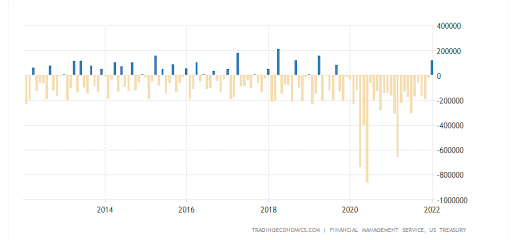
Of course, this shouldn't come as a surprise given what we wrote previously that the US government has been running a budget surplus in 2022. Indeed, this is the first time since April 2019 that the government ran a budget surplus:


And what happened in the months that followed that budget surplus? The yield curve inverted, and Google searches for "recession" hit their all-time highs:


And while HY spreads are unchanged from a year ago, they have been creeping up so far in 2022:


These are all ominous signs of an imminent recession and/or risk-off event. Prepare accordingly... 

Wednesday, February 9, 2022

Yield Curve Is (Still) Flattening, Liquidity Is Evaporating

There was a lot of excitement late last week about the BLS report showing US nonfarm payrolls added 467,000 jobs in January, and revising the prior period up by nearly 200,000, handily beating expectations.

While it's worth noting that there were some revisions to prior-reported data as part of its annual review, this is undoubtedly good news about the health of the economy and further supports the fiscal stimulus measures enacted by Congress in 2020 and 2021.

Per the WSJ, the report caused stocks to rise and bonds to fall.

(Side note - I have always been skeptical when I read or hear in the news about some presumed cause/effect relationship with regards to that day's news and the price action in financial markets. In the real world, investment decisions are frequently made days, weeks, even months in advance and are completely unrelated to what the mainstream media is reporting. Frustrating, but that is the world we live in.)

And while it's true that bonds largely sold off on Friday, what's more important is that the 2yr/10yr spread continued to fall, reaching its lowest level since October 2020. Per Bloomberg:


The fact that this is happening is an indication that monetary conditions are too tight. Interest rates are the price of credit money. Like any other commodity, money gets priced on a curve, at the intersection of supply and demand, over a period of time. New money supply is added through two channels: commercial bank loans and fiscal spending. As time passes, money is constantly being created and destroyed: money is created when banks make loans or the government injects new money, and it is destroyed as loans and taxes are paid off. Bank lending is primarily driven off of income: a loan is made if the lender believes the borrower has capacity to service its debt given their income. If long-term rates are falling relative to shorter term rates, that is an indication that demand for long-term borrowing is weak, forcing lenders to lower their rates. Perhaps people don't feel confident about their future income prospects, so they hold off on making long-term purchases like homes and autos. When this happens, banks are forced to lower rates (prices) in order to encourage people to borrow and spend.

Likewise, rising short-term rates indicate that current demand for money is on the rise, hence the price is going up. A flattening yield curve is therefore a signal that there are too few dollars in the economy: near-term demand for dollars is rising at the expense of future dollars. 

Without a surge in bank lending (which requires people to feel confident about their capacity to service debt with incomes earned) or fiscal spending (which requires cumbersome political processes), the supply of dollars across the time continuum is somewhat fixed. People need cash now, and they have limited access to cash in the future (for myriad reasons) so they borrow short-term, which leaves fewer dollars leftover for future spending. Given spending = income in aggregate, lower future spending means lower future income.

Per the aforementioned BLS report, the labor force participation rate (62.2%) and employment-population ratio (59.7%) remain below February 2020 levels, which were themselves unimpressive after declining for two decades. Fewer people working is a drag on the economy, limiting its full productive capacity and therefore suppressing incomes available for workers. Limited income for workers means fewer people feel comfortable taking out a long-term loan.

The government could fix this with a Job Guarantee. I also firmly believe that a student debt relief program would create new capacity for borrowers, and jumpstart the economy. Without these kinds of programs (or some other stimulus), however, I expect the curve to keep flattening as we head closer to recession.

There are already signs that economic growth is slowing. PayPal (PYPL) provided weak guidance on its earnings call last week, sending the stock down 24% in a day, citing a slowdown in consumer spending, particularly among low-income earners. They cited Omicron, inflation, and the lack of fiscal stimulus as contributing factors.

Likewise, mortgage loan servicer loanDepot (LDI) indicated on a recent earnings call that cash-out refi's were going to be much lower in 2022 than in 2020. Cash-out refi's are an important source of liquidity for consumers, and a slowdown there suggests that liquidity will tighten - consistent with earlier points about tighter monetary conditions. With fewer dollars to go around, sales and incomes should stagnate.

If there was ever a sign of tightening liquidity, consider that Meta Platforms (FB, formerly Facebook) recorded the largest market cap loss ever last week at $232 billion after a terrible earnings print. Meanwhile, Snap Inc. (SNAP) shot up nearly 60% after hours last week, adding around $23 billion to its market cap. The fact that megacap tech companies are suddenly trading like penny stocks is a sign of a lack of liquidity in the markets. Expect more volatility ahead.

And who can be expected to be a beneficiary of this volatility? I'll save that for a future post. Hint: It was one of the companies included in my Financials model portfolio posted on earlier this year.


On Inflation

[Note: I originally started writing this piece on December 23, 2022, then got held up with holiday festivities. More posts for the new year ...